|
If we expect to be a growing enterprise, we have
to continue to pursue business performance improvements.
We must take
advantage of every innovation to stay in the game. Higher
margins are in—as well as market share. So, responding
to markets—in the fast lane is critical. So, there
is a case for real-time—we call it small smart
and fast. In the supply chain there is time-free interdependency,
which means we must have up to the minute data that reflects
the reality of the source—what is happening at that
source—now. And we must be able to depend on the accuracy
of that source data. Even though a process ‘changeover’ may
not occur (like tearing down a line to build a different
product), the knowledge that that data is available is critical
to businesses’ planning and execution. Many business
processes do depend on instant data, and though some organizations
may not always ‘act’ on this, possessing that
data limits the propagation of error—which is the leading
source of the staggering supply chain waste we have in most
industries and the loss of market share.
Evolution of Information Cycle Time
The current buzz around execution systems does not invalidate
the purpose of planning. We need planning and execution—but
the whole process must happen faster. Assumptions during
planning cycle can be wrong. These assumptions migrate
from the planning system and get baked into the execution
systems driving poor promotion management, excess procurement
spend, etc.
And for some companies who have implemented planning, the
numbers are looking better.[1] (Figure
1) But there is still much to be done. Benefits are not shared
equally across the chain—which means costs
and prices are still higher than need be, and the imbalance
is leaving some firms very exposed. (Figure 2) Retailers
are doing very well in general, but down the chain there
are challenges.
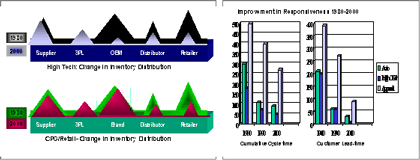
FIGURE 1
Though the cycle times have gotten better,
the dollars baked into those times are still in the billions.
And expect cycle times to go up with various global trade
compliance regulations and issues[2].
Especially from the mid-tier firms, who frequently are not
early adopters of tech, the
cynical responses that sometimes get airtime on not needing ‘real-time’,
don’t have legs. You are the ones who are being hurt
the worst. And the reluctance to adopt tech (i.e. startup
costs, etc.), have basically gone away with many of the SCM
network providers.
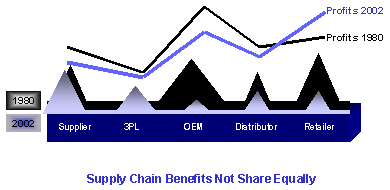
FIGURE 2
The Trading Network:
Network components are: The planning layer is Marketing/and
SCM Strategies. The execution layer is Sales and Fulfillment.
This can be composed of both internal and external components-
a commerce front end and the fulfillment supply chain network.
This total network requires real-time reasoning and
the ability to seek out subscribers of information to perform
their roles, based on process and policy thresholds required
for the business interaction in play. We call this the
Trading Network. Here is where the operations of the SmallSmartFast firm
are executed. My planning activities may be in my core—conducted
for the benefit of revenue and strategic planning, but
tactical supply chain planning is an element
that I share with the network. S&OP can also be built
on a cross-enterprise consensus platform—like real-time
smart conferencing, simulation and reasoning.
But my SmallSmartFast technology needs just that—a
very fast interaction/information bus to conduct commerce—that
is not being provided by the ERP systems we have today. Too
many layers exist between reference data (customer lists,
pricelists, etc.), so these have to be exposed to the trading
network. Possibly, the data can be managed at the network
hub—a.k.a. UCC standard, plus Semantical remapping
services to translate me-to-you. A sharable hub
can also eliminate the data propagation, screening, updating,
etc.
etc. that happens when data is moved from company to company.
This architecture needs absolute scalability if it is to
host as a system of record, as well as speed to deal with
the traffic of RFID and instant messaging. It also needs
to manage the convergence of voice, radio frequency, Internet,
wireless transactions. Visibility and Synchronization,
please-SmallSmartFast!
Here in the following chart (figure 3) we see the evaluations
of information cycle time and the resulting support chain
metrics. It is getting wayyyyyyyyyyyyyy better!
In this article, we are just focusing on the business case—at
a high level. Think about which SCM operating metrics will
be impacted due to the reduction of information cycle times.
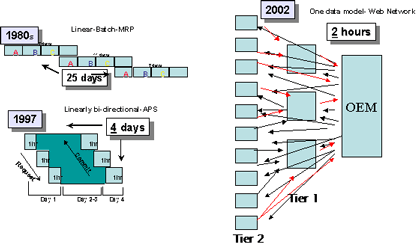
FIGURE 3
Business Case Concepts:
Many of these new software firms derive their revenues from
set-up costs and transaction fees. Many users are excited
about the low set-up costs but find transaction fees to be
the ‘hidden costs’.
Think about these things:
- When initiating a relationship:
- Cost Avoidance
- While getting
new capabilities—you are now
engaging with world-class software with out capitalizing,
managing
complex accounting activities etc.
- You do not have to buy hardware, software and
a programming support staff.
- Activation fees are usually based on the number
of processes and documents you will manage—clean
up your act and you will have very low set-up
fees
- Business Value:
- Expect operational improvement in these areas:
- On-time delivery-Customer Sat
- Inventory Turns
- Cycle times
- Responsiveness
- Delivery times
- But beyond that, look to the long-term opportunities
of having an end-to-end system of record.
This will allow you
to evaluate not just your performance,
but also that of your trading partners—suppliers,
carriers, etc.
- In operation
- You do not have to focus on
upgrades and maintenance issues again. The costs of
maintenance of hardware and people
is not yours.
- You can significantly reduce the number of transactions
by cleaning up your data! Although many of the network
firms tell us that after going live, the number
of transactions
goes way up (trust in the system), which they love.
Users get antsy on this front. But you can manage
this by making
sure that these transactions are trade activities—not
error corrections, which are the predominant number
of transactions.
- Get your trading partners to participate.
This enhances the value to the whole
trading network, of course:
- Speeds up commerce
- Reduces admin costs
- Improves data quality
- Improves operating metrics.
Conclusion:
Living in the network means to leverage existing capacities
and investments. That gives you a small investment profile
for a smart platform. And as time goes on, more and more
capabilities will be put into these platforms.
It appears that the global economy is beginning to pick
up some steam. That’s great. But it also means facing
up to speed—you have to be fast—in all the activities
in your business.
[1] Stay
tuned for our up coming report on SCM success
[2]
Next month, Parallax View will cover Global Logistics
as well as updates from the CLM conference
©2003
ChainLink Research, Inc.
|